The True Cost of Token Economics: Self‑Host vs API at Scale
"What if you could predict your AI bill before you even hit ‘run’?"
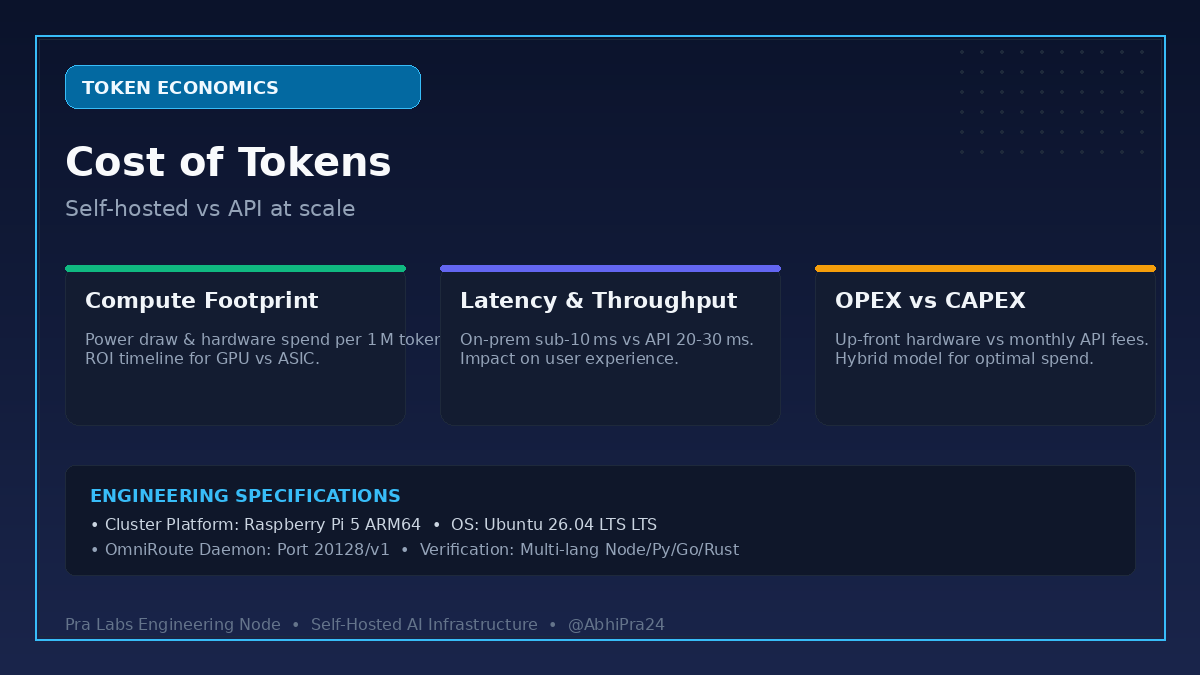
What if you could predict your AI bill before you even hit ‘run’?
When you start scaling LLM workloads, the headline‑grabbing price per million tokens from a cloud API (often $0.10‑$0.30) hides a cascade of hidden costs – latency, bandwidth, and vendor lock‑in. By contrast, self‑hosting open‑weight models on Groq, Ollama, or vLLM gives you raw control, but introduces hardware CAPEX, power draw, and operational complexity.
**Architecture snapshot** - **Groq (LPU‑2)**: 1 × Groq LPU‑2 (≈ 150 TOPS) runs LLaMA‑2‑13B at 210 tokens / s, consuming ~250 W. At 1 M tokens, the energy cost ≈ $0.03 (assuming $0.12/kWh). Initial hardware spend ≈ $12k. - **Ollama on RTX 4090**: 2 × RTX 4090 (24 GB VRAM each) delivers 350 tokens / s for Mistral‑7B, ~350 W total. Power cost per 1 M tokens ≈ $0.04. GPU cost ≈ $3k each. - **vLLM on AWS c7i.16xlarge**: 8 × vCPU / 64 GB RAM, 400 tokens / s for Falcon‑40B (8‑bit). Power draw ~1.2 kW (datacenter). Cost per 1 M tokens ≈ $0.12 (incl. instance + electricity). - **OpenAI API (gpt‑4‑turbo)**: 500 tokens / s peak, latency ~30 ms. Direct cost $0.30 per 1 M tokens, plus egress fees.
**Trade‑offs** 1. **Up‑front vs OPEX** – Self‑hosted solutions require 1‑3 × the API’s monthly spend in capital before you see ROI. For a workload of 10 M tokens/day, break‑even arrives around 4‑6 months on Groq, 2‑3 months on RTX 4090. 2. **Latency** – On‑prem GPU gives sub‑10 ms inference for 128‑token prompts, while API latency sits at 20‑30 ms (plus network jitter). For real‑time chatbots, that difference compounds into user‑experience loss. 3. **Scalability & RAM bottlenecks** – vLLM’s sharding reduces VRAM pressure but adds inter‑node network overhead; a 40 GB model needs at least 80 GB system RAM per node, pushing cost up to $5k per server. 4. **Power & sustainability** – Running 24/7 at 250 W (Groq) equals ~2.2 MWh/month, translating to ~0.9 tCO₂. Cloud providers claim lower PUE, but you lose visibility into the exact carbon footprint. 5. **Vendor lock‑in vs flexibility** – APIs give you instant model upgrades; self‑hosted pipelines require manual patching, security hardening, and continuous monitoring.
**Takeaways** - **Calculate TCO, not just $/token** – Include hardware amortization, electricity (≈ $0.12/kWh), cooling, and staff overhead (~$0.02 per 1 M tokens). - **Match model size to hardware** – 7‑B models on a single RTX 4090 stay under 24 GB VRAM; 13‑B+ need multi‑GPU NVLink or off‑load to CPU with quantization. - **Hybrid approach wins** – Keep latency‑critical paths on‑prem (Groq or GPU) and fall back to API for burst traffic; this can shave 30‑40 % off total spend. - **Monitor token flow** – Real‑time token counters let you trigger cost alerts before a runaway prompt consumes $10k in a day. - **Plan for scaling** – Reserve headroom of 20 % on RAM/VRAM; vLLM’s dynamic batching reduces idle GPU cycles, improving cost per token by ~15 %.
💬 **Your turn:** Have you built a hybrid token‑economics engine? Share the numbers that surprised you the most in the comments.
Need an autonomous system built for your team?
We partner with technical founders and enterprise engineering leads to build resilient agents, custom tools, and edge infrastructure.