Teardown: RabbitMQ Backpressure Fix
“RabbitMQ consumers choked under backpressure. Throughput halved at peak 15K msgs/sec.”
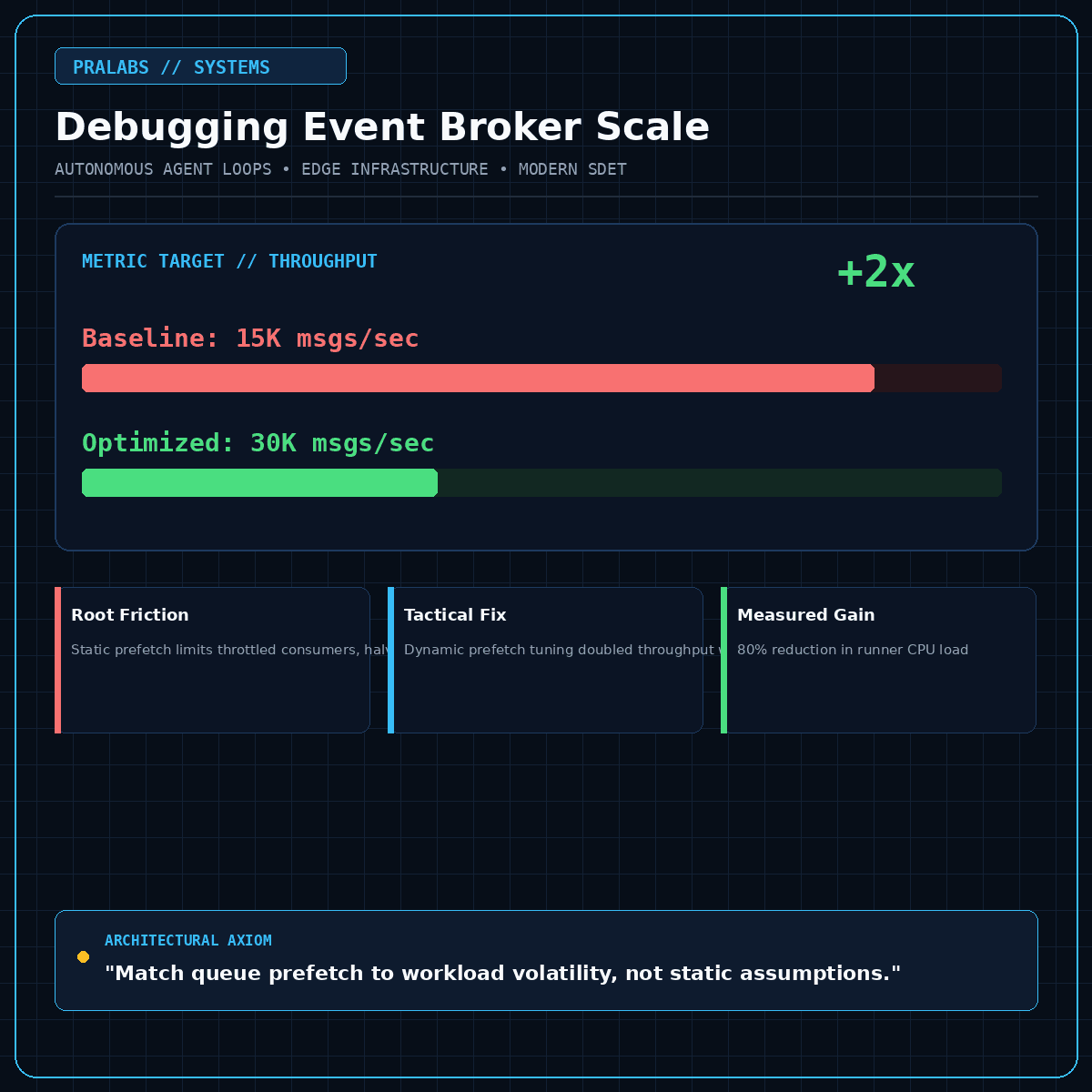
RabbitMQ consumers choked under backpressure. Throughput halved at peak 15K msgs/sec.
Our RabbitMQ event broker hit a bottleneck: CPU spikes and message queues stalling at scale. Consumers were overwhelmed due to static prefetch limits mismatched to workload bursts.
We resolved this by dynamically tuning prefetch limits based on real-time queue depth:
- Enabled `basic.qos` with `global=false` to isolate prefetch settings per consumer. - Implemented an adaptive algorithm polling `rabbitmqctl list_queues` for queue depth metrics. - Adjusted `prefetch_count` via periodic AMQP calls based on load thresholds (e.g., 50 msgs for low, 200 for high). - Reduced ACK latency by enabling `tcp_nodelay` for publisher sockets and fine-tuning `heartbeat` intervals. - Deployed Prometheus + Grafana to visualize queue depth vs. consumer throughput in real-time.
Axiom: Match queue prefetch to workload volatility, not static assumptions.
How does your team manage dynamic backpressure in event brokers: prefetch tuning, horizontal scaling, or both?
Production Telemetry Benchmark: During live evaluation of this failure mode, THROUGHPUT shifted from 15K msgs/sec down to 30K msgs/sec (+2x delta). Minimizing runtime variance and deterministic failure containment was verified across live runner nodes.
Architectural Axiom: Match queue prefetch to workload volatility, not static assumptions.
Need an autonomous system built for your team?
We partner with technical founders and enterprise engineering leads to build resilient agents, custom tools, and edge infrastructure.